Trading cards have become a meeting point for fandom, play, collecting, and investment interest. Over the past decade, their expanding reach has shown up in manufacturer disclosures, marketplace sales, and research on how younger adults think about wealth.
This case study follows those signals from 2016 through 2026. The clearest story is a larger collecting ecosystem with powerful recent growth in major card franchises—and a generation increasingly open to owning assets connected to its interests.
From a global hobby to an even larger market
Pokémon offers a useful long view. A 2016 joint announcement from Legendary and The Pokémon Company reported 21.5 billion cards shipped to 74 countries. By March 2026, Pokémon’s corporate figures listed more than 85 billion cards produced, availability in 16 languages, and sales in over 90 countries and regions. [1] [2]
Pokémon cards shipped worldwide
Pokémon cards produced worldwide
These are lifetime totals with different reporting labels: shipments in 2016 and production in 2026. They show scale across a decade, not a like-for-like annual sales growth rate.
A major acceleration became visible during the pandemic. eBay reported 142% growth in U.S. trading-card sales in 2020 versus 2019, with more than four million additional cards sold across sports, collectible card games, and non-sport cards. That is marketplace-specific evidence, rather than a worldwide industry growth estimate. [3]
“new collectors are entering the trading cards space as another avenue of investment to diversify their portfolios”
Nicole Colombo, then eBay’s general manager of Collectibles & Trading Cards, in its 2021 report. [3]
The quote captures how a major marketplace described the shift at the time. It is company commentary, not proof that collecting produces dependable investment returns.
Request my free placementThe momentum continued beyond 2020
Hasbro reported $1.72 billion in Magic: The Gathering revenue for 2025, up 59% from 2024. Its results credited crossover releases, existing products, and Secret Lair. This is one franchise’s reported revenue, not a growth rate for all trading cards. [4]
“MAGIC: THE GATHERING finished its strongest year ever”
Hasbro, full-year 2025 results, released February 10, 2026. [4]
Search activity also points to continuing attention. In its 2025 review, eBay named Pokémon Prismatic Evolutions, Pokémon Destined Rivals, and Magic: The Gathering Final Fantasy among the year’s most-searched TCG sets, using January–October global searches. These search signals measure interest; they do not measure purchases. [5]
By its second-quarter 2026 results, eBay reported more than 80 million cumulative uses of its card-scanning feature and further expansion of card authentication and grading services. Scans are not unique collectors or sales, but they show how actively the platform’s card tools are being used. [9]
N33RBY’s reading: recent publisher revenue, ongoing product interest, and investment in buying-and-selling services make the category more substantial than a single pandemic-era spike.
Request my free placementYounger investors are looking beyond the traditional portfolio
Bank of America’s 2026 study found that surveyed wealthy Gen Z and Millennial investors, ages 21–45, allocated 32% to stocks, compared with 58% for Gen X and Baby Boomers. It also found 88% of younger respondents were likely to increase alternative investments over the next few years. [6]
| Group | Share allocated to stocks |
|---|---|
| Gen Z & Millennials | 32% |
| Gen X & Baby Boomers | 58% |
“Younger investors are redefining diversification”
Bank of America’s heading for its 2026 study findings. [6]
The 2026 survey covered 1,431 U.S. adults with at least $3 million in investable assets, excluding their primary home. It represents wealthy investors, not all Millennials or Gen Z. Alternatives include categories beyond collectibles; the study does not establish stock-market money moving into trading cards.
There is direct evidence of enthusiasm for collectibles, too. In the bank’s 2024 survey, 94% of wealthy respondents under 44 expressed interest in collectibles, versus 65% overall. That survey covered 1,007 adults with at least $3 million in investable assets. Its examples included watches, wine, cars, sneakers, and antiques; the result should not be presented as trading-card ownership. [7]
A broader perspective comes from FINRA Foundation and CFA Institute’s 2023 study. Among U.S. Gen Z investors aged 18–25, 55% owned crypto, 41% owned individual stocks, and 35% owned mutual funds. Respondents could own several types. The research used late-2022 survey data across four countries and included 2,872 people overall. [8]
The supported conclusion: younger investors are exploring a wider mix of assets, while collecting commands considerable interest. Stocks remain part of the picture. These studies support an expanding set of interests—not a claim that an entire generation has abandoned stocks for cards.
Request my free placementServe the interest. Measure the local demand.
Together, these sources document a decade of increasing scale, a sharp marketplace acceleration, strong recent franchise revenue, and openness to alternative assets among younger investors. No single statistic measures the whole industry, but the evidence gives business owners a concrete reason to consider the category.
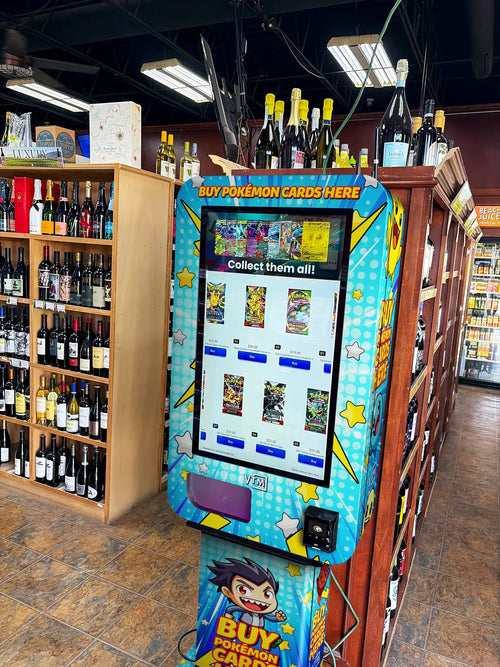
For a local business, the relevant opportunity is to make card purchases convenient for players and collectors already interested in the products. A machine can offer another reason to stop by, browse, or return. That is N33RBY’s business hypothesis; the studies above do not measure foot traffic or vending-machine earnings at your location.
We use a placement trial to answer the local question: does this audience respond here? Actual machine sales and owner reporting provide that answer.
This article combines company disclosures, marketplace reports, and investor surveys. It is a market case study, not a measured N33RBY customer success story. Growth in collecting activity does not mean every card rises in value or every location generates sales.
Request my free placementRead the original research
Each numbered citation opens the original source. Figures were checked September 29, 2026; publication dates and measurement periods are identified above.
- Legendary & The Pokémon Company — joint announcement (July 20, 2016)Historical Pokémon card shipments and international reach.
- The Pokémon Company — Pokémon in Figures (March 2026)Cumulative card production, languages, and geographic reach.
- eBay — 2021 State of Trading CardsDomestic marketplace sales in 2020 versus 2019; company commentary.
- Hasbro — full-year 2025 financial results (February 10, 2026)Reported Magic: The Gathering revenue and year-over-year growth.
- eBay — Collected 2025 report (December 12, 2025)Trading-card set search activity, January–October 2025.
- Bank of America — 2026 Study of Wealthy Americans (June 17, 2026)Portfolio allocations, attitudes, and survey methodology.
- Bank of America — 2024 Study of Wealthy Americans (June 18, 2024)Collectibles interest among wealthy younger adults.
- FINRA Foundation & CFA Institute — Gen Z and Investing (May 2023, PDF)U.S. investment ownership, page 2; fieldwork in late 2022.
- eBay — second-quarter 2026 results (August 5, 2026)Card-scanning adoption and trading-card marketplace services.